

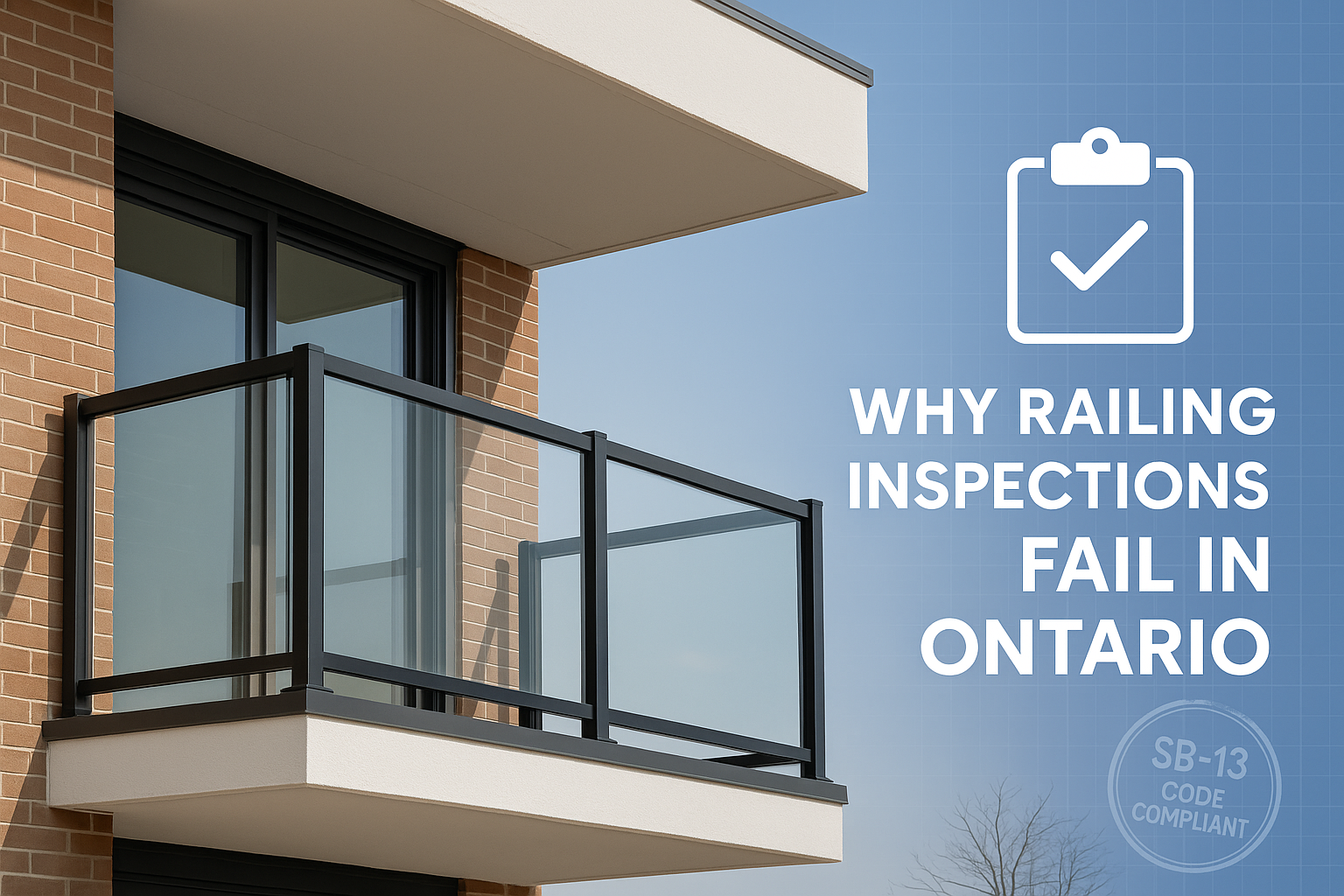
Failed railing inspections are one of the most common — and expensive — setbacks in Ontario renovation and construction projects.
Homeowners lose time.
Builders lose schedules.
Property managers inherit liability.
Across Ontario, deck, balcony, stair, and pool railing failures regularly trigger inspection rejections under the Ontario Building Code (SB-13). Most of these failures are preventable.
This guide explains exactly why railing inspections fail, what inspectors look for, and how to avoid costly tear-outs and rework.
The Real Cost of a Failed Railing Inspection
A failed inspection is rarely a minor fix.
In many cases, it results in:
Partial or full removal of the railing system
Re-fabrication of components
Project delays or missed occupancy dates
Additional permit or inspection fees
Engineering letters or remedial work orders
Most failures occur because railings are installed without being engineered for inspection, not because inspectors are unreasonable.
1. Incorrect Railing Height (The #1 Failure Reason)
Incorrect guard height is the most common issue inspectors flag.
Ontario Building Code Minimum Heights
36 inches (915 mm) – Residential decks, balconies, and landings
42 inches (1065 mm) – Commercial, multi-unit, and many municipal requirements
👉 Learn more in our guide:
Ontario Building Code 101: Railing Heights & Safety
Why Projects Fail
Assuming 36" is always acceptable
Municipalities defaulting to 42"
Finished surfaces changing final height
Measuring to the wrong reference point
If the finished guard height is even ½ inch short, the inspection fails.
2. Violating the 100 mm (4-Inch) Opening Rule
Ontario code is explicit:
A 100 mm (4 inch) sphere must not pass through any opening in a guard.
This applies to:
Aluminum picket spacing
Glass railing gaps
Post-to-glass transitions
Stair guard openings
Common Mistakes
Decorative spacing that exceeds limits
Horizontal elements that allow climbing
Improper spacing near posts or stair returns
Inspectors physically test openings. If the sphere passes, the railing fails.
➡️ Related service:
Aluminum Railings
Glass Railings
3. Non-Compliant Glass in Guard Applications
Glass railings fail inspections more often than people expect.
Approved Glass Types
Tempered safety glass
Laminated safety glass (in specific applications)
Common Failures
Using standard window glass
Glass that is too thin for guard loads
Missing polished edges
No certification or documentation
Glass must be clearly identified as safety glass. If documentation is missing, inspectors may require replacement.
➡️ Related service:
Glass Railings
Glass Enclosures
4. Improper Anchoring & Structural Support
A railing can look solid and still fail inspection.
Inspectors evaluate:
How posts are anchored to framing or concrete
Fastener type and embed depth
Blocking beneath surface mounts
Load resistance (people leaning, wind, snow)
Why This Fails
Posts fastened only to deck boards
Missing blocking below surface mounts
Incorrect concrete anchors
No structural consideration for load paths
This is especially common in retrofits and DIY installations.
5. Climb Hazards from Horizontal Components
Ontario Building Code prohibits guards that are easily climbable by children.
Typical Violations
Horizontal rails
Decorative cross-members
Cable rail systems without proper spacing
Even if spacing technically meets the 100 mm rule, climbability alone can cause failure.
6. Pool Fence & Pool Railing Violations
Pool enclosures are governed by stricter rules, often enforced at the municipal level.
Common requirements include:
Minimum 48-inch height
Self-closing, self-latching gates
Latches out of child reach
No horizontal climb features
Proper gate swing direction
Glass pool fences frequently fail due to:
Incorrect gate hardware
Insufficient glass thickness
Improper latch placement
➡️ Related service:
Pool Fences
7. Missing Documentation or Engineering Support
Even properly built railings can fail if documentation is missing.
Inspectors may request:
Manufacturer specifications
Glass safety certification
Engineering letters (commercial or remedial work)
Shop drawings
Installers using third-party kits or imported systems often cannot provide this, resulting in failed inspections.
➡️ Commercial & remedial work support:
Commercial Aluminum & Glass Solutions
Why Manufacturer-Installed Systems Pass Inspections More Often
Inspection failures most often occur when:
Components come from multiple suppliers
Installers do not control fabrication
Systems are modified on-site instead of engineered
At Aluminum Solutions:
Railings are designed to SB-13 from the start
Fabrication, glass preparation, and installation are handled in-house
Spacing, height, and anchoring are engineered — not guessed
Documentation is available when inspectors request it
This significantly reduces inspection risk.
Build for Inspection — Not Just Appearance
Railing inspections fail not because inspectors are difficult, but because many systems are not built to code from the outset.
If a railing:
Looks good but wasn’t engineered
Fits visually but not dimensionally
Was installed without structural planning
…it is vulnerable to failure.
Planning a Railing Project in Ontario?
If you’re:
Replacing a failed railing
Closing an open permit
Preparing for inspection
Renovating a deck, balcony, or pool area
Our team can review your project and ensure it meets Ontario Building Code (SB-13) before installation.
👉 Get a Code-Compliant Quote